
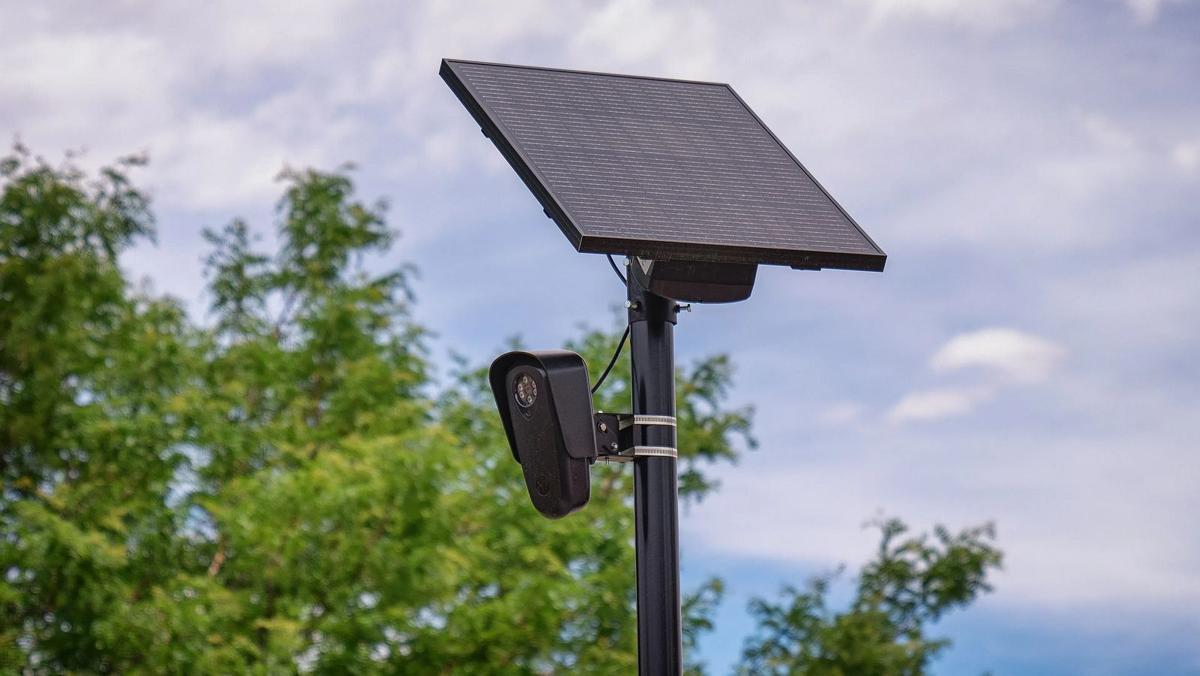
(The Center Square) – The ongoing debate around Flock cameras and other automated license plate reading systems, or ALPRs, is garnering attention from elected officials and candidates up and down the ballot.
And it’s a topic not solely falling along partisan lines.
“I would welcome bipartisan legislation to ban these across the state,” Gov. Josh Shapiro, a Democrat, said in response to a question from The Center Square late last month. “This is not something I support.”
“This is not something in the public interest,” he continued. “I think law enforcement needs to have tools to keep communities safe. Flock cameras are not a tool that I support.”
State Treasurer Stacy Garrity, Shapiro’s Republican challenger for governor, shared a similar sentiment in early September.
“Flock cameras are an intrusive invasion of privacy and they should be banned,” she said.
Although both candidates for governor seem to be on the same page about Flock cameras, President Donald Trump doesn’t appear to share those concerns.
“I like them,” Trump said, in response to a question on Air Force One, specifically citing some support in law enforcement in helping combat crime.
The Center Square contacted each Democratic and Republican Party candidate running in battleground congressional districts – whose races could determine which party will hold the majority come 2027 – about their positions on the use of Flock cameras and similar ALPRs.
"Flock and Flock-like cameras track where law-abiding people go, who they visit, and how they live - all without a warrant. All of that information is for sale to anyone or any government,” U.S. Rep. Scott Perry, a Republican representing the state’s 10th Congressional District, told The Center Square. “I was the first Member of Congress who actually did more than talk about it by forcing an amendment vote. While that vote failed in Committee, that's not the end of this. I'm committed to stopping the Surveillance State and ending this invasion of our privacy."
Perry, an ally of Trump’s and former chair of the conservative U.S. House Freedom Caucus, has been outspoken on the issue, taking to social media calling on Congress to “Stop the Flock.”
Noting the unique nature of this debate, MS NOW notes that Perry and Democratic U.S. Rep. Jesús García of Illinois tried to ban the use of federal highway funds for license plate readers, but the attempt ultimately failed.
Perry, a seventh-term incumbent, is headed for a rematch this November against Democrat Janelle Stelson, a former central Pennsylvania television anchor. The Cook Political Report and Sabato’s Crystal Ball, a pair of national ratings outlets, describe the race in the 10th District as a “toss up.”
Stelson’s campaign did not respond to multiple requests for comment from The Center Square.
However, in a story about Flock cameras in Harrisburg in July, her campaign told ABC27 that “as the daughter of a state trooper, Janelle stands with local law enforcement and will work with anyone in Congress to give them the tools they need to tackle crime and save lives.”
The race in the Lehigh Valley for Pennsylvania’s 7th Congressional District between U.S. Rep. Ryan Mackenzie, a Republican, and Democrat Bob Brooks, a firefighters union leader, is also viewed as a “toss-up” by national pundits.
Both candidates highlighted their concerns about the technology, as well as its potential upside, depending on its use.
"There are legitimate concerns and questions being raised about a single, private company organizing the collection of detailed travel information,” Mackenzie, a first-term incumbent serving in Congress, told The Center Square. “While law-enforcement often uses similar technology in police cruisers, the expansiveness of the Flock network and its constant surveillance of individual citizens raises important questions about privacy and civil liberties.”
“As these conversations continue in Congress, I will be working with members on both sides to explore commonsense guardrails for these technologies to protect all Americans,” Mackenzie added.
Brooks pointed to his background as a firefighter in his response to how he views the technology.
"I spent 20 years putting out fires and running into danger, so I understand why law enforcement wants every tool they can get to do their jobs,” Brooks told The Center Square. “If they could use the Flock cameras to catch bad guys, that's fine by me. But there's no reason they should be storing innocent people's info, that's an infringement of privacy and un-American.”
Just north of the Lehigh Valley is home to another closely watched “toss-up” race between U.S. Rep. Rob Bresnahan, a freshman GOP lawmaker, and Scranton Mayor Paige Cognetti, a Democrat, for Pennsylvania’s 8th Congressional District.
“While these cameras are useful for police investigations and real-time alerts, Americans understandably have concerns about their privacy that must be addressed,” Bresnahan told The Center Square. “Public safety is critically important, but it should not come at the cost of limitless mass surveillance.”
“As we move forward on this issue, we must put guardrails in place that protect law-abiding citizens and limit the collection, retention, and sharing of their location data to legitimate public-safety purposes,” he added.
Cognetti’s campaign did not respond to multiple requests for comment from The Center Square about her position on the use of Flock cameras and other similar ALPRs.
Republican U.S. Rep. Brian Fitzpatrick, co-chair of the bipartisan Problem Solvers Caucus, is facing Bucks County Commissioner Bob Harvie, a Democrat, for the state’s 1st Congressional District. The race between Fitzpatrick, first elected to represent the district in the suburbs north of Philadelphia in 2016, and Harvie is also expected to be close, with Sabato’s Crystal Ball giving the slight edge to the incumbent, describing it as “leans Republican.”
In late August, Fitzpatrick penned a letter to U.S. Attorney General Todd Blanche and Federal Trade Commission Chairman Andrew Ferguson expressing his belief that proper oversight of Flock security camera systems nationwide is necessary.
“AI-powered license-plate reader systems like Flock can help law enforcement identify vehicles tied to criminal activity, but documented cases show the technology has also been used to track women, former partners, and others for unauthorized purposes,” Fitzpatrick wrote on social media. “Now, I’m calling on the Department of Justice and Federal Trade Commission to establish clear federal standards for their use.”
“Law enforcement should have every effective tool it needs to protect our communities—but technology this powerful must come with equally strong safeguards against abuse,” he continued.
Harvie’s campaign did not respond to multiple requests for comment from The Center Square about his position on the use of Flock cameras and other similar ALPRs.
Flock has argued that it has been an effective tool for solving crime across the country.
Flock Safety issued a 2025 Impact Census earlier this year that they said found that its technology “supported more than 1 million investigations, assisted in solving 20% of cleared cases, helped locate more than 10,000 missing persons, and contributed significantly to stolen vehicle recoveries across the country.”
The topic is expected to garner headlines on Wednesday afternoon when a Senate Judiciary subcommittee will hold a hearing on Flock cameras and AI surveillance.
Earlier this month, a group of bipartisan lawmakers in Congress introduced the “Flock-Off Act,” which would cut off federal funding for Flock-style surveillance by prohibiting the use of federal funds to purchase, install, maintain, operate, or upgrade automated license plate readers and biometric surveillance cameras.
The issue has also been a topic of discussion for lawmakers serving in Pennsylvania’s General Assembly for nearly a month.
Republican state Sen. Dan Laughlin, who represents Erie County, said he plans to introduce legislation that would prohibit the use of Flock Safety cameras and substantially similar networked ALPR systems in the state, citing growing concerns that the technology could become a system of mass surveillance.
“Some of these systems do much more than record what happens in a public place,” Laughlin said. “They automatically identify vehicles, catalog their movements and enter that information into a searchable network. That makes it possible to track and reconstruct where a person has traveled over time, even when that person has done nothing wrong.”
State Sen. Lisa Boscola, a Democrat representing parts of Lehigh and Northampton counties, said her bill would ban “knowingly accessing or using an automated surveillance system, or information obtained through such a system, for an unauthorized personal or otherwise unlawful purpose.”
There are several other proposals that lawmakers serving in Harrisburg have said they will introduce to limit the use of Flock cameras.
However, there are a few members who have introduced legislation that would expand the use of Flock cameras and similar ALPRs, believing it can be a tool that can combat crime.
“ALPRs are among the most effective tools available to law enforcement today. These systems capture computer-readable images of license plates and vehicles, allowing police officers to compare plate numbers against databases of stolen vehicles, wanted individuals, and other serious crimes,” the co-sponsorship memo reads for Senate Bill 933.
That bill, introduced last year, has the support of seven Republican senators.
They said their proposal would use this technology “on state-owned infrastructure across the Commonwealth for law enforcement purposes.”
Sixteen states, according to the National Conference of State Legislatures, have laws that “expressly address” the use of the cameras.