
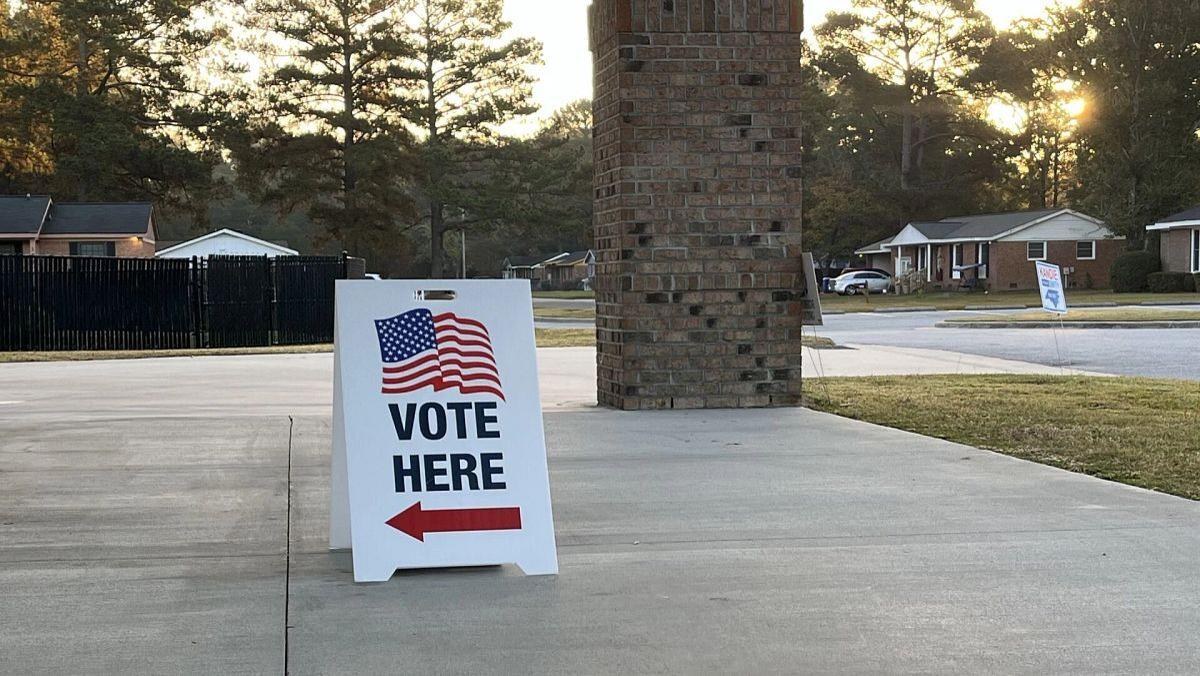
(The Center Square) – By 490 registrations, Democrats for the first time since January have more than Republicans in North Carolina, say public records of the State Board of Elections analyzed by The Center Square.
Each major party, however, continues to fall more distantly behind those choosing no affiliation.
Saturday’s seven-day update pushed the statewide total to 7,881,478. The unaffiliated bloc has 3,168,005 (40.2%), Democrats 2,331,133 (29.6%) and Republicans 2,330,643 (29.6%).
The other parties recognized by the state are Libertarians (46,697) and the Green Party (5,000).
Absentee voting for any registered voter requesting a ballot started with the Sept. 4 mailing by county boards of elections, opening the nation’s longest voting window of 61 days. Early in-person voting is Thursday through Oct. 31. Election Day is Nov. 3, with all absentee ballots due to county board offices by 7:30 p.m. when polls close.
Friday marked the end of registering to vote, sans early in-person voting.
The Center Square analyzes the registration trend as part of its mission for reporting taxpayers' views, government accountability, and the intersection at the ballot box that will shape policy impacting Americans across multiple areas.
Voter roll maintenance, standard and as required by state law, and a trend away from parties since Election Day 2024 have continued to swell the independents and weaken the major parties in registration numbers.
Not only did Democrats regain the second spot among the three largest voting blocs, the party also took a 35.5% share of net registration changes during the week. The independent bloc captured 58.1% and Republicans just 5.8%.
Last week’s seven day update included 12,853 registrations net gain total overall, with 7,466 independent, 4,565 Democrats and 742 Republicans.
Since the primary, the 173,218 net gain in voter registrations has gone 146,785 to the unaffiliated bloc, 17,485 to Democrats, and 8,400 to Republicans.
Since Election Day 2024, the 41,567 net gain in voter registrations has gone 208,999 to the unaffiliated bloc, with losses of 121,614 by Democrats and 16,429 by Republicans.
For additional context, at what is generally considered a landmark Election Day in 2008, the state’s total registrations were 6,264,733. Those unaffiliated numbered just under 1.4 million (22.2%) while Democrats’ 2,866,669 had 45.8% share and Republicans’ 2,002,416 was a 32% share. Barack Obama became the first Democrat since Jimmy Carter in 1976 to carry the state, by a mere 14,177 votes of more than 4.3 million cast, on the way to winning the White House.
Neither Obama nor Carter managed to carry the state in their reelection bids.
The state’s lone U.S. Senate seat in 2008 was won by Democrat Kay Hagan, and the 13 U.S. House seats were divvied up eight Democrats and five Republicans. Democrats are 0-5 in Senate races since.
The Council of State went 8-2 to Democrats. Incumbent Republicans’ Steve Troxler and Cherie Berry remained commissioners of agriculture and labor, respectively. And the General Assembly was 30-20 Democrats in the Senate and 68-52 Democrats in the House of Representatives.
Today, Republicans have won the state in the presidential race 13 of the last 15 contests (1968-present), five consecutive U.S. Senate races (2010-present), and two years ago captured 10 of 14 seats for the U.S. House.
The Council of State is a 5-5 split. On Election Day 2024, the General Assembly majorities were 30-20 Republicans in the Senate and 71-49 Republicans in the House of Representatives.