
(The Center Square) – Incumbent Democratic Justice Anita Earls has roared ahead of Republican challenger Sarah Stevens in polling for North Carolina’s lone state Supreme Court election.
Earls leads 47.2%-36.4% in the Carolina Journal sampling conducted with Harper Polling. Respondents numbered 608 on Sunday through Tuesday earlier this week, and the analysis carries a +/- 3.97% margin of error.
The August polling by Carolina Journal on the race had Earls up 43.3%-39.7% though within the +/- 4% margin of error for a statistical tie; Earls led in May 41.3%-35.6% outside the +/- 4% margin of error; and Earls led in March 40.6%-38%, also a statistical tie within the +/- 4% margin of error.
In August, Earls led Stevens 47%-44% in a High Point University Poll that was a statistical tie having landed within the +/- 4.3% margin of error. In a July sampling by Public Policy Polling, the duo was also statistically tied inside a +/- 3.6% margin of error with Earls up 44%-42%.
Earls, a Seattle native, was a founder of the Southern Coalition for Social Justice before winning election to the Supreme Court in 2018. Stevens resigned from the North Carolina House of Representatives effective June 16 to focus on her campaign, having served District 90’s Surry and Wilkes counties in the northwestern region of the state along the Virginia border.
For the nationally watched election to succeed Republican Sen. Thom Tillis in the U.S. Senate, Democrat Roy Cooper leads Republican Michael Whatley 49.2%-34.1%. That’s an increase on August when Cooper led 51.5%-39%, in May when Cooper led 49.8%-38.7%, and in March when Cooper led 48.9%-41.1%.
Asked “how likely would Roy Cooper be to support the policy priorities of the Democratic Socialists of America if elected,” respondents overwhelmingly connected him at 60.1%-20.7% for likely or not likely.
The Democratic Party, on a national scale, has tension in an ideological tussle for control. Democratic socialism is on the rise, replete with a desire not only for social reforms but also restructuring, including abolishing the U.S. Senate, having Congress pick the president and U.S. Supreme Court, defunding the Pentagon, and allowing all residents, regardless of citizenship, to vote.
The difference was greater asking if Whatley would support Trump policies, though there is no surprise since the latter wanted him to chair the Republican National Committee in his election campaign of 2024. The poll was 73.9%-9.2% on likely to not likely.
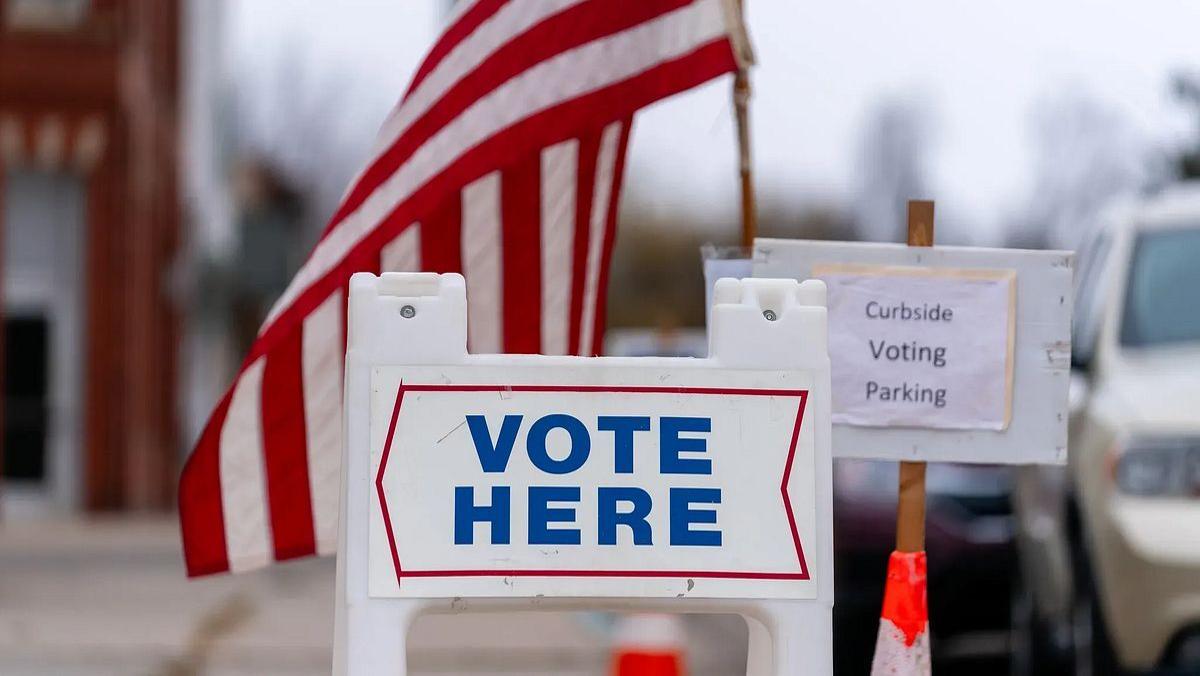
Absentee voting began on Sept. 4 with the mailing of ballots to the nearly 50,000 requesting them, opening a 61-day window to Nov. 3. Oct. 9 is the voter registration deadline.
Absentee requests do not require a reason; anyone can file with their respective counties. The deadline for an absentee ballot in the mail to be in a county election board office is when the polls close at 7:30 p.m. on Nov. 3; the request deadline is 5 p.m. on Oct. 20.
Early in-person voting is Oct. 15-31, and same-day registration is permitted.
North Carolinians will choose a U.S. senator, all 14 members of the U.S. House, and all 170 members of the General Assembly. One state Supreme Court seat and a number of judges, district attorneys, and county level offices are on the state's second-longest ballot of the four-year cycles.
Cooper’s bid to succeed Tillis would be trend-breaking if successful. Tillis, Richard Burr and Ted Budd have made Republicans 5-for-5 since Democrat Kay Hagan won election to the U.S. Senate in 2008.
Republicans in statewide races for this decade – 2020, 2022 and 2024 – are 32-10 against Democrats, a party with significantly declining voter registrations for more than 20 consecutive years.
This U.S. Senate seat is viewed as a major player nationally in the quest for a majority in the chamber. Republicans have 53 seats today. In no particular order, Ohio, Michigan, Georgia, Maine, Iowa, New Hampshire, Alaska, Texas and Montana are the other top battlegrounds among 35 races. Two of those are special elections, the other 33 are in regular rotation.