
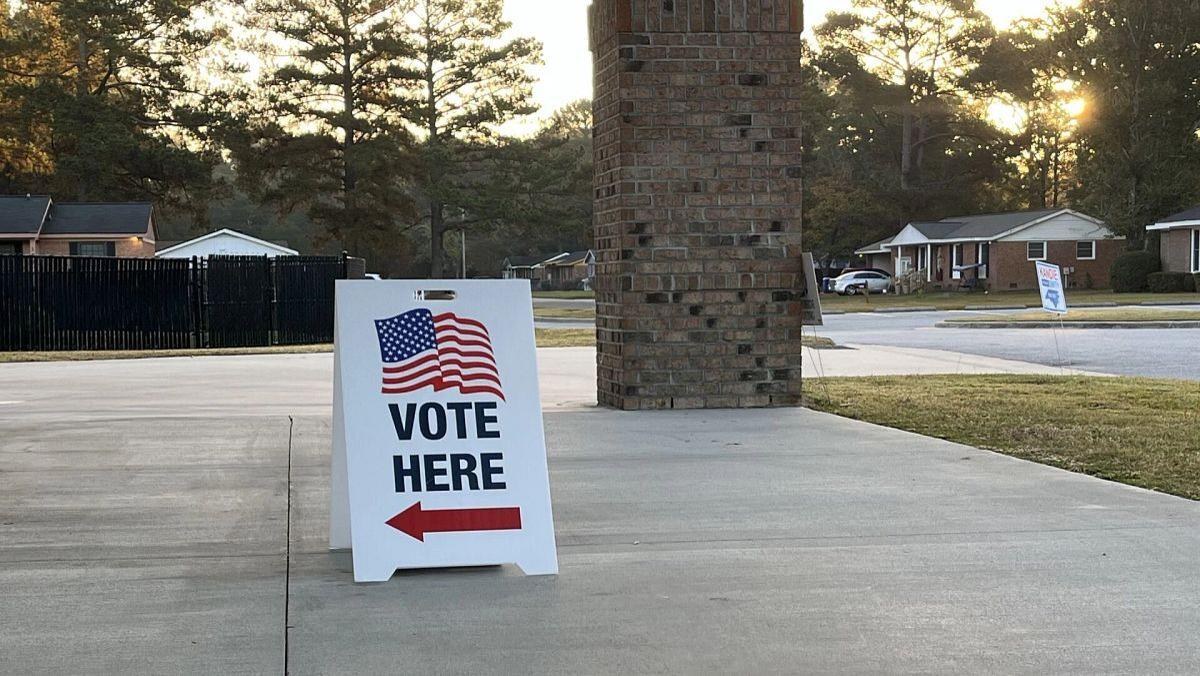
(The Center Square) – More than 2 million ballots have been cast through absentee mail and early in-person voting in North Carolina, with the latter wrapping up Saturday.
Election Day is Tuesday.
North Carolinians will choose a U.S. senator (six-year term), all 14 members of the U.S. House (each a two-year term), and all 170 members of the General Assembly (each a two-year term). One state Supreme Court seat (eight-year term) and a number of judges, district attorneys, and county level offices are on the state's second-longest ballot of the four-year cycles.
Three constitutional amendments are also on the ballot.
The U.S. Senate race to succeed two-term Republican Sen. Thom Tillis is a four-candidate race led by Democrat Roy Cooper and Republican Michael Whatley. Cooper leads in fiscal strength, polling strength and – on a point more debated as positive or negative – carries 38 years of elected office experience. Whatley’s party has won five consecutive Senate races in the state and hasn’t lost a midterm for Senate since 1998.
The U.S. House of Representatives split today is 10 Republicans and four Democrats. Republican state lawmakers redrew the 1st and 3rd congressional districts in October to potentially gain an 11-3 advantage, hoping to end an 0-for-71 slide dating to an 1882 election win in the northeastern-most corner of the state.
To be expected as second-term Republican President Donald Trump’s agenda hits this midterm cycle, Democrats have momentum and gained more when Republican Rep. Chuck Edwards in the 11th Congressional District withdrew his reelection bid in early August because of an ethics censure.
Democrats say they have chances beyond expected reelection bids of Reps. Deborah Ross (2nd Congressional District), Valerie Foushee (4th) and Alma Adams (12th) and the tossup between incumbent Democratic Rep. Don Davis and the Republican challenger, retired Army Col. Laurie Buckhout, in the 1st Congressional District.
The bid in the 11th Congressional District by Jamie Ager against Republican state Rep. Jennifer Balkcom is projected as Democrats’ biggest chance to flip a red seat blue. The party says other wins are possible in the 3rd Congressional District where Dr. Raymond Smith challenges incumbent Republican Rep. Dr. Greg Murphy; in the 9th with retired Army Maj. Richard Ojeda challenging incumbent Republican Rep. Richard Hudson; and the 13th with Paul Barringer trying to unseat incumbent Republican Rep. Brad Knott.
Any other state in the nation would be hard-pressed for a U.S. House headline result to top or match should Democrats pull off going from a projected deficit of 11-3 to a modest 8-6 advantage, particularly in a state won three times by Trump.
One state Supreme Court race is in the cycle. Incumbent Democratic Justice Anita Earls is challenged by Republican former state Rep. Sarah Stevens. Earls represents one of two seats on the seven-member bench for her party.
The General Assembly at the 2024 election shook out to a 30-20 Republican majority in the Senate and 71-49 Republican majority in the House of Representatives.
Expected to be tested as they seek upper chamber reelection are Republican Sens. Buck Newton in District 4, Michael Lee in District 7, Lisa Barnes in District 11, and Danny Britt Jr. in District 24, and Democratic Sens. Lisa Grafstein in District 13 and Woodson Bradley in District 42.
In races without an incumbent, eyes are on recently appointed Democrat Haseeb Fatmi in District 18 and Republican Kevin Crutchfield in District 34, where the primary winner unseated an incumbent.
For the lower chamber, seven districts among a consensus pivotal 26 potentially will be under closer watch than the others. They include District 25 from Nash County, Districts 35 and 37 from Wake County, District 73 from Cabarrus County, Districts 98 and 105 from Mecklenburg County, and District 115 from Buncombe County.
Others where wins by either party would not be a major upset are District 5 in the northeastern part of the state; District 7 in Franklin and Vance counties; District 9 in Pitt County; District 12 in Greene, Jones and Lenoir counties; District 20 in New Hanover County; District 24 in Nash and Wilson counties; District 26 in Johnston County; District 32 in Granville and Vance counties; District 43 in Cumberland County; District 48 in Hoke and Scotland counties; District 54 in Chatham and Randolph counties; Districts 59 and 62 in Guilford County; Districts 63 and 64 in Alamance County; Districts 74 and 75 in Forsyth County; District 82 in Cabarrus County; and District 119 in Jackson, Swain and Transylvania counties.
Some are more in play than others. For example, Democratic Rep. Robert Reives is the incumbent in District 54, minority leader of the chamber and aiming to win a seventh election after originally being appointed in January 2014. In District 48, Democratic Rep. Garland Pierce is seeking a 12th term yet he’s also among those multiple times helping Republicans with a needed vote or more to override vetoes.
On the other hand, two years ago Democratic Rep. Dante Pittman, in District 24, unseated Republican Rep. Ken Fontenot by 871 votes of more than 41,000 cast. In District 32 two years ago, Democrat Bryan Cohn unseated Republican Rep. Frank Sossamon and cleared a protest to win by 228 votes of more than 42,000 cast.
Ballot referenda collectively in North Carolina are unique to the nation – the only state with personal income tax, property tax and voter photo identification in the three constitutional amendments. Since 1985, North Carolina’s 30 statewide ballot measures have had just five defeats.
In an Elon University Poll released in September, requiring photo identification for all forms of voting, including absentee mail-in ballots, drew a 63%-25% approval; changing the constitution to lower the allowable state personal income tax rate from 7% to 3.5% was favored 67%-18%; and allowing the General Assembly to limit increases in property taxes from local governments is favored 72%-14%.
North Carolina voters in 2018 endorsed presenting photo identification when voting in person. Litigation, led in part by Cooper as governor, led to implementation delayed until the 2023 municipal races.
The amendment would make the April 2023 ruling by the state Supreme Court constitutional. The state’s highest bench said photocopies of photo IDs were to go in with ballots mailed, or completion of an ID Exception Form.
The referenda are at the end of the ballot. For this one, the ballot asks voters to vote for or against, “Constitutional amendment to require all voters, not just those presenting to vote in person, to present photo identification before voting.”
The state’s individual income tax is a flat rate of 3.99% and scheduled to continue dropping to 3.49% in 2027, 3.24% in 2030 and 2.99% in 2033. After 2034, revenue-triggered cuts could get it to 2.49%. The amendment puts a cap of 3.5% starting in 2027. Today, in the general statutes, the cap is 7%.
The ballot asks voters to vote for or against, “Constitutional amendment to keep the state income tax rate from being raised higher than three and one-half percent (3.5%).”
The property tax amendment does not set a floor or cap; rather, it says lawmakers are to pass laws limiting how much local governments can increase total property tax revenue from year to year. It does set a “levy limit” capping growth in total dollars. Exceptions could be granted by the lawmakers.
The ballot asks voters to vote for or against, “Constitutional amendment requiring limits on property tax increases by local governments.”