
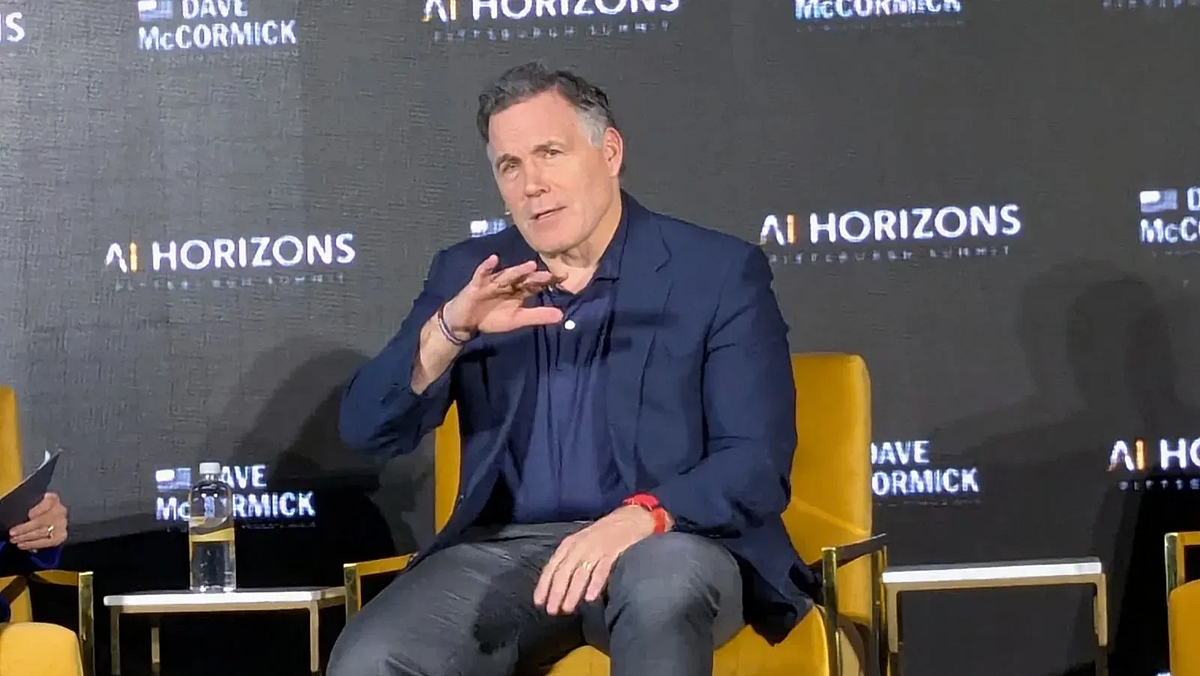
(The Center Square) – U.S. Sen. Dave McCormick, R-Pa., says putting AI regulation in the hands of the federal government poses risks and instead offered a different solution that he believes would be better equipped to handle the evolving technology.
“I do think the idea of an industry-led group, maybe FINRA-like, where they establish regulations and oversight and compliance is a good idea,” McCormick said during an interview on Fox News Sunday.
FINRA, under the oversight of the Securities and Exchange Commission, or SEC, is a self-regulatory organization for member broker-dealers that is responsible under federal law for supervising member firms. Its mission is to “protect investors and safeguard the integrity of our vibrant capital markets to ensure that everyone can invest with confidence.”
“It has to be well orchestrated, but I think putting this in the hands of the government poses two risks,” McCormick explained. “Number one, the government isn't really capable of monitoring some of these models.”
When making his case that the federal government isn’t best equipped to regulate AI, he pointed to the federal government’s response to the coronavirus pandemic and handling of Silicon Valley Bank.
“Even if people are well-meaning, we just don't have the capability to oversee and make decisions,” McCormick argued.
The second point, McCormick said, was that he doesn’t want to give the government “consolidated control” over AI.
“I think we need to guide and guard against some of these worst case scenarios,” McCormick said. “But we need to be very careful we don't stifle innovation, and industry needs to take the lead.”
McCormick’s stance appears to differ from Gov. Josh Shapiro, who delivered an address last week arguing that President Donald Trump’s administration is not doing enough to address growing concerns of AI.
“I've called on the federal government to step up and regulate the AI industry, just like they do for nearly every other industry that significantly impacts our lives,” Shapiro said on Thursday.
Last week, Trump dismissed calls for government regulation of AI.
“The only control or “guardrails” that AI needs is a STRONG AND SMART (High IQ!) PRESIDENT, and the U.S.A. has that, in spades!” Trump wrote on social media on Sept. 14. “The Trump Administration has stopped AI “people” from doing bad, or potentially bad, “things,“ like Dario (Anthropic!), who is now pretending to be a “perfect little angel” - and we will continue to do so!”
“We already have tremendous CRIMINAL and REGULATORY power over these companies!,” he continued. “There is a SICK conspiracy going on against AI and Data Centers, and the only one that is happy about it is China. WHOEVER WINS AI, WINS! We are leading China, and all others, and will continue to do so. Conspiracy Theorists, Treasonists, Traitors, and Leakers, BEWARE! Thank you for your attention to this matter! President DONALD J. TRUMP.”
Jensen Huang, President and CEO of NVIDIA, believes that it is the responsibility of AI companies to “develop the technology safety and to properly test it.”
“I think we should consider further legislation that the liability rests with the companies,” McCormick said.
Trump, on Saturday, published a different post on social media seemingly agreeing with McCormick, saying that his administration “will not in any way hinder or stifle the Growth of this incredible Industry,” but floated a different solution by creating an “AI Force.”
“Rather, we will cherish it, help it, and watch over it, as it grows! However, we will also be looking for BAD, and we can do that, very easily, with our already existing Criminal and Civil Justice System,” Trump said. “For this purpose, I am forming the AI Force, much like I did Space Force, which has been a tremendous SUCCESS, in my First Term. To that end, I will be announcing, in the near future, the AI “Czar” — Only High I.Q. individuals need apply!”
“AI is the next Industrial Revolution, or Internet, but will be even larger and more impactful, possibly as much as 25% of our Country’s GDP,” the president added. “We are leading China, and the rest of the World, and I intend to keep it that way!”
While adding responsibility is with the tech companies, “I’m not saying that this should be absent from the government’s involvement,” McCormick argued, and referenced Trump’s plan.
McCormick acknowledged the benefits and concerns Americans have with AI.
“This technology offers enormous benefits, productivity improvements, solving rare diseases,” he said. “This is incredible.”
“It also poses risk in terms of disruption in the economy, the job market, in terms of wealth concentration, possibly in terms of bioterror or something like that,” he continued.
Like Trump, McCormick described the AI race as a battle with China and said it was important that the U.S. continues to lead. He also said he “largely agreed” with Jensen that companies are responsible for “ensuring that they're not creating things that can be harmful to the citizenry.”
“I do think we need to have additional oversight,” McCormick said during an interview Friday on 1210 WPHT. “I do think we need to have the people who are capable of it, and I do think the government getting in the middle of it is more likely to create more risk.”
McCormick made the case that the executive branch can move faster than the Senate and suggested another potential solution for handling AI concerns.
“I was on a call earlier today with Senator Fetterman and he was proposing, which I think is a good idea, that there might be a dedicated department, a dedicated cabinet secretary that would focus solely on this, like we did with Homeland Security after 9/11,” McCormick said on Friday.
McCormick and Shapiro may have some common ground on the need to communicate with China over AI.
“I'm mindful that we are just one state, and despite our commitment to collaboration and the leadership of folks in this room and throughout the region, we can't address this alone,” Shapiro said last week. “It's going to require national, in fact, international leadership and collaboration.”
While describing himself as a China hawk, McCormick did discuss the need for communication with them.
“I do think some channel on AI is necessary,” McCormick argued.
When defending his position, McCormick, a military veteran, cited the U.S. maintaining open lines of communication with the Soviet Union during the Cold War.
“I think we should be very skeptical of the Chinese,” McCormick said. “But I do think engaging on this most important thing going on in the world right now is an important part of protection.”
“We need to have open channels of communication because if you don't have that, then you might assume it's purposeful,” he said. “And what we're learning with AI is sometimes these things happen without us having adequate controls. And so that's the balancing act. And if you basically say we're going to just stop, as some people have called for a pause on AI development: you can do that, but the Chinese, who are our biggest adversary, are going to take the lead.”
The comments from McCormick and Shapiro come just days after some of the top AI companies issued a warning about the advancements made in AI and the threats it poses to humans losing control over the technology.
Trump is slated to meet with Chinese President Xi Jinping at the White House this week.