
(The Center Square) – Pennsylvania’s longstanding role as a leader in energy production is entering a new chapter with the arrival of a company that is turning air into fuel.
AIRCO, formerly Air Company, recently relocated from Brooklyn, N.Y. to Bucks County, Pa., to start a new hub for research, development, engineering, and manufacturing of advanced fuel technologies. Its proprietary AIRMADE technologies convert carbon dioxide into synthetic fuels – including diesel and jet fuel – which the company says could have implications for national security and global fuel supply.
Although the facility will produce some fuel, its primary focus is manufacturing its MAD (Mobile, Adaptable, and Dynamic) Fuel Systems, which are designed to produce fuel near the point of use, potentially reducing dependence on vulnerable fuel supply lines.
“For over a century, fuel has been produced in centralized refineries and shipped around the world. We’re changing that,” said Gregory Constantine, co-founder and CEO of AIRCO, at a ribbon-cutting event on Oct. 28. “This facility enables us to manufacture autonomous systems that produce fuel anywhere, on demand. It’s a fundamental shift from fuel as a commodity to fuel as infrastructure.”
Constantine said they plan to mass manufacture modular e-fuel production units that can be deployed anywhere there is a power source, reducing transportation costs and vulnerability.
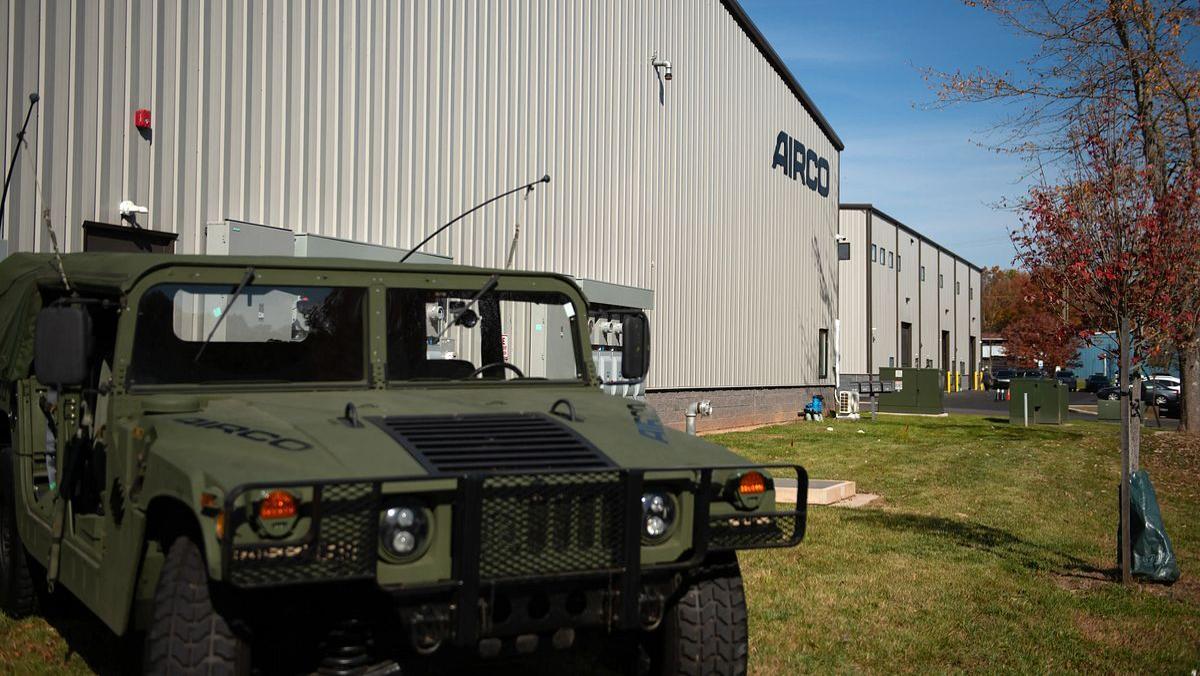
He drove up to the stage with recently defeated U.S. Rep. Brian Fitzpatrick, R-Pa., in a Humvee powered by fuel made at the site. He noted that other equipment being used at the event, such as the sound system, diesel generator, and coffee truck, were also running on its fuel.
Fitzpatrick said that energy security is national security, and the technology has the potential to reduce vulnerabilities, strengthen the U.S. defense industrial base, and give service members greater flexibility and security wherever they are deployed.
Developing the technology for use in remote locations also presents challenges, including obtaining the CO2 needed to produce fuel.
Tristan Wells, a process engineer on AIRCO’s operations team, told The Center Square the company’s core technology converts carbon dioxide into fuel. To make the systems self-sufficient in remote settings, they are working in tandem with partners developing technology that captures carbon dioxide directly from the atmosphere.
Wells said widespread adoption will require companies working together to develop the necessary infrastructure, but he sees many interesting applications for the technology.
“It’s kind of the tip of the iceberg right now…but there is a lot of opportunity,” he said.
Attendees donned lab coats and safety glasses before touring the facility with Nick Steinke, AIRCO’s director of government and defense programs.
Steinke described how the company is scaling its technology from laboratory development to commercial production.
Current prototype systems allow engineers and chemists to study individual processes and improve efficiency. An integrated pilot plant combines those processes to produce fuel for ASTM and military certification testing. The pilot system produces approximately 40 gallons of finished diesel fuel per month.
The next step is manufacturing MAD One, a modular system designed to produce approximately 1,000 gallons of diesel or jet fuel per month. Steinke said the company initially expects to manufacture one or two units monthly at the new facility, eventually increasing production to four.
Steinke said the facility currently relies on grid electricity, but deployed systems could draw from a variety of sources, including small modular nuclear reactors, geothermal, solar, and wind. “Similar to the CO2, we’re power agnostic as well. So, we’re not tied to a single type of power. We use any of it,” he said.
AIRCO has also received a Strategic Funding Increase, or STRATFI, award from AFWERX, the innovation arm of the Department of the Air Force, to advance development of its MAD Fuel System. The company reports additional government contracts involving NASA and the Defense Innovation Unit, along with partnerships with commercial aviation companies, including JetBlue and Virgin Atlantic.