
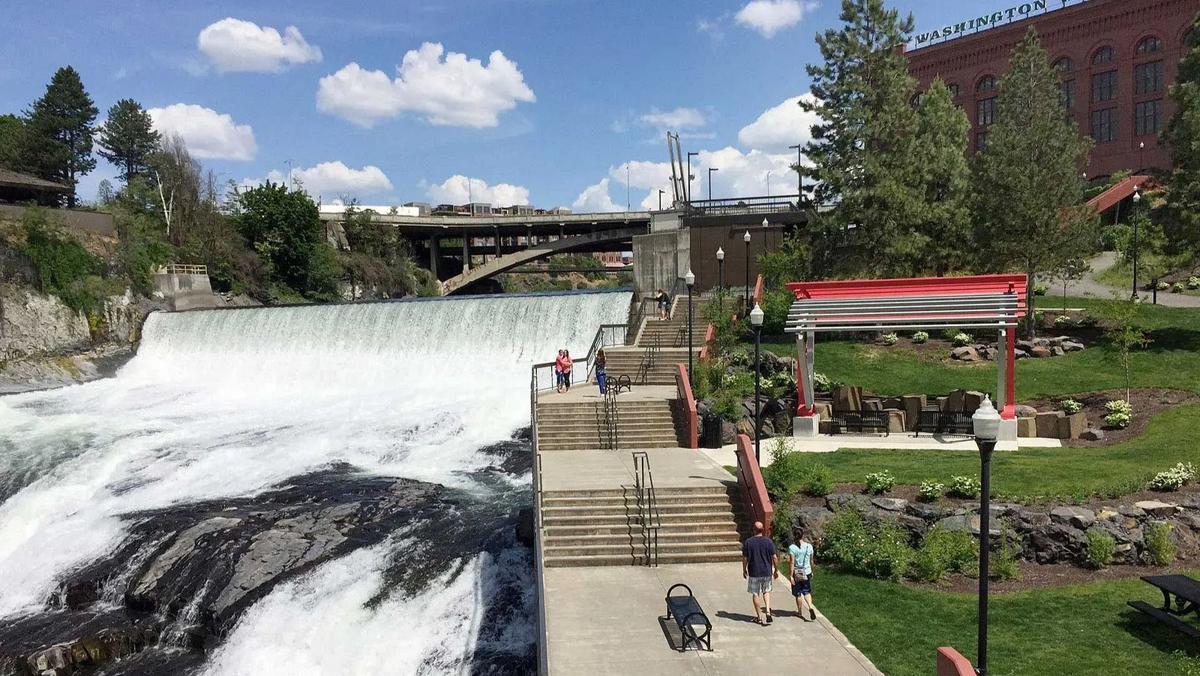
(The Center Square) - The City of Spokane is seeking more than $4.6 million in state grants for three park projects, with officials arguing the applications will leverage local dollars already committed through a voter-approved parks levy.
The five grant applications submitted by Spokane Parks & Recreation total $4.641 million and ranked among the top six applications in their respective Washington State Recreation and Conservation Office programs.
The projects include renovations at Franklin Park and Minnehaha Community Park and a new non-motorized water access point along the Spokane River at the Iron Bridge.
The RCO Board is scheduled to vote on the ranked grant lists Oct. 27. The Legislature would then have to provide funding for the grant programs in the state's 2027-29 capital budget before Spokane can receive the awards.
The requests come as Washington lawmakers prepare for a difficult budget cycle. The state's June revenue forecast said weaker economic activity had reduced projected revenue by nearly $1 billion from the February forecast and that lawmakers would face a greater shortfall in the 2027-29 biennium than previously expected.
But state Sen. Marcus Riccelli, D-Spokane, said RCO grants generally are not competing with the state's operating budget in the same way as programs that require ongoing state expenditures.
“The majority of the state’s capital budget is funded with bonds that cannot be used for operating, and most RCO grants don’t come with ongoing state operating costs for the projects themselves,” Riccelli said.
Washington's 2027-29 budget process is underway, with state agencies submitting their biennial budget requests to the Office of Financial Management in September.
How much local money is involved?
The city is not simply putting up $4.641 million in local dollars to receive an equal amount from the state. The local match varies by project and includes money from various sources.
For the Franklin Park Sports Complex, Spokane is requesting $1.5 million through the RCO Youth Athletic Facilities program.
The project already has $18.9 million in matching funding from the Spokane parks levy, a Spokane Public Schools bond and donations, according to information provided by Riccelli.
The project would replace five heavily-used baseball and softball fields that have been in their current configuration since the 1980s. Spokane estimates about 4,500 young people use the complex each year, while more than twice that number are on a waitlist for public fields.
The proposed renovation would create a five-field youth baseball and softball complex with artificial infields, lighting, fencing, dugouts, restrooms, walkways, spectator areas and parking. The city estimates the expanded complex could serve approximately 10,000 youth annually.
At the Iron Bridge River Gateway, Spokane is seeking two grants totaling $1.465 million — $500,000 through the Aquatic Lands Enhancement Account and $965,000 through the Washington Wildlife and Recreation Program.
Riccelli said the Iron Bridge project has $553,000 in matching funding from the city parks levy.
The project would create a new public launch for non-motorized recreational watercraft along the Spokane River. Plans also call for about half an acre of landscaping and nearly 200 feet of streambank restoration.
The third project is the Minnehaha Community Park Redevelopment, for which Spokane is seeking two grants totaling $1.676 million.
The city is requesting $500,000 through the Washington Wildlife and Recreation Program and $1.176 million through the Youth Athletic Facilities program for a pump track.
Voters approved local funding
The city says the state grant applications are part of the parks investment Spokane voters approved last year.
Spokane voters approved a $240 million, 20-year parks levy in November 2025, with 55.8% voting in favor. The levy is intended to fund improvements throughout the city's park system.
Spokane City Councilmember Michael Cathcart said he supports using levy dollars to help match the grants because the projects were part of the parks plan presented to voters.
“I do in this instance because they are projects that were part of the parks plan,” Cathcart said. “The message was communicated to the public — leveraging local dollars and grants.”
Cathcart said he supported the levy and has been a particularly strong advocate for the Minnehaha redevelopment.
He said the city should follow through on the projects voters approved rather than redirecting levy dollars to unrelated needs.
“It's a question of what did the voters say, and they approved it,” Cathcart said. “You can't transfer dollars to the general fund. We said we would do X and we did it.”
Cathcart also said pursuing the RCO grants allows the city to bring additional money into projects it has already committed local funding toward.
What about the state's budget?
The state's financial picture is putting pressure on lawmakers as they prepare the 2027-29 budget.
The June revenue forecast projected $82.16 billion in Near General Fund revenue for 2027-29, but economic changes reduced the forecast by $450 million compared with February. The Office of Financial Management said the changes add to the expected shortfall facing lawmakers.
That does not mean RCO funding would come directly out of the state's operating budget.
Riccelli said lawmakers still have to weigh parks and recreation against other capital needs competing for state funding.
“The projects submitted ranked very high and are within the funding window,” Riccelli said.
He said he supports the Spokane applications, particularly the Minnehaha redevelopment and Iron Bridge project.
For Minnehaha, Riccelli said he is focused on creating more opportunities for children and families to use the park.
“I am particularly supportive of our investments in parks from a health aspect,” Riccelli said.
He said the city has an opportunity to leverage the parks levy and school bond with state funding.
“I do think leveraging the dollars from the broadly supported infrastructure investments in the joint school bond and parks levy is exactly what citizens want to see to activate more spaces in our community,” Riccelli said.
Riccelli said lawmakers will have to consider a range of infrastructure requests during the budget process.
“I do think it is important to weigh a myriad of different infrastructure investments in our community,” he said.
Cathcart said the parks projects should not be viewed as competing directly with other city priorities because the levy money is restricted to the purposes approved by voters.
He said Spokane has significant needs beyond parks, but those needs involve different funding sources.
“We have huge needs, don't get me wrong,” Cathcart said. “But separate issues and conversations.”